
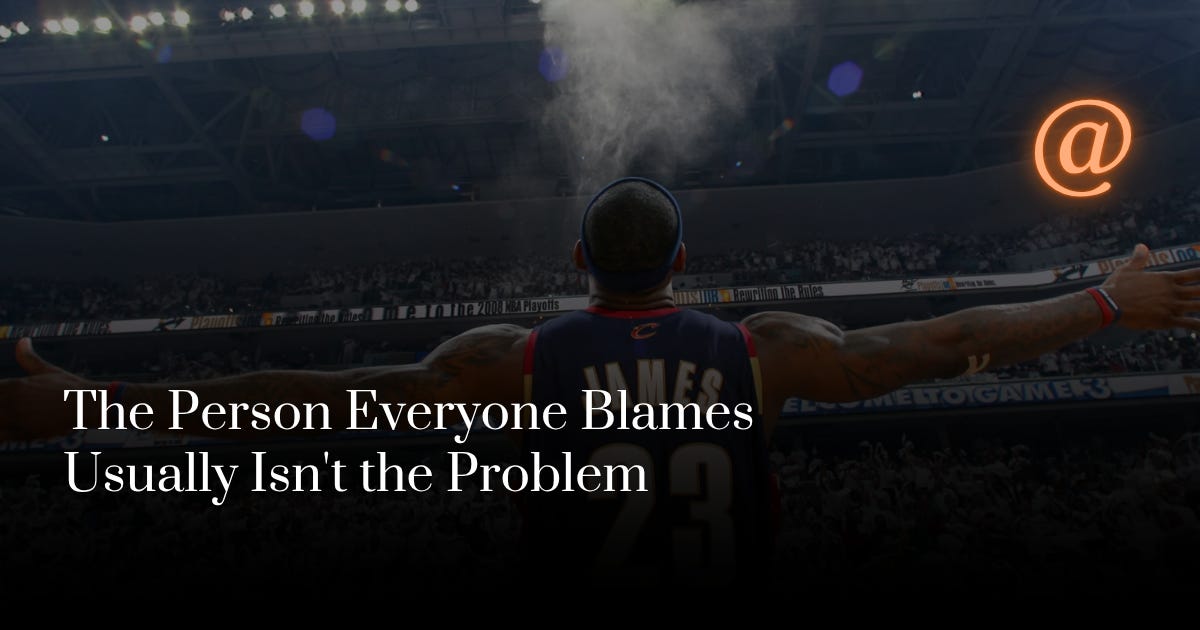
I recently watched a clip of Alfonso Ribeiro talking about basketball. He reflected on the different eras of the NBA, the Magic Johnson and Larry Bird rivalry, Michael Jordan finally getting over the hump, the Shaq and Kobe dynasty, and eventually the conversation turned to LeBron James.
His opinion wasn’t new.
I’ve heard some version of it for years.
LeBron’s decision to leave Cleveland for the Miami Heat, he argued, ruined basketball.
Whether you agree with that statement isn’t what caught my attention.
What caught my attention was realizing that I think we’re arguing about the wrong thing.
The more I thought about it, the more I began to ask myself a different question.
What if this was never really about LeBron?
What if it was about the story we’ve been telling ourselves about success?
For decades, the story was simple.
A superstar gets drafted.
He stays loyal.
He battles through adversity.
He finally wins a championship.
It’s a story we love because it makes success feel deeply personal. One extraordinary individual overcomes impossible odds and reaches the top.
It’s inspiring.
It’s memorable.
It’s also incomplete.
I’ve noticed something about the way we tell stories.
We almost always tell them through people, even when the real story is about the system surrounding them.
We celebrate the CEO.
We criticize the president.
We praise the coach.
We blame the quarterback.
We glorify the superstar.
Rarely do we stop to ask what made their success, or failure, possible in the first place.
We don’t misunderstand greatness.
We misunderstand what makes greatness possible.
Championships aren’t won by one player.
They’re won by organizations.
Ownership matters.
Leadership matters.
Scouting matters.
Player development matters.
Coaching matters.
Medical staffs matter.
Role players matter.
Culture matters.
The superstar may be the face of the organization, but he has never been the organization itself.
Yet when the confetti falls, we hand one person the credit.
When the season ends in disappointment, we hand him the blame.
That’s an impossible standard.
Imagine spending years being told that your legacy depends on one thing.
Winning.
Now imagine hearing that every week before you’ve even reached your prime.
You’re not great because you haven’t won.
You’ll never be Jordan because you haven’t won.
You’ll never be one of the greatest because you haven’t won.
Eventually, criticism stops sounding like analysis.
It starts sounding like a verdict.
That’s why I’ve never been surprised that LeBron left Cleveland.
Not because loyalty doesn’t matter.
But because responsibility has limits.
When you’re expected to carry expectations that the people around you aren’t equipped to support, eventually you start looking for an environment where success is actually possible.
Most of us would.
LeBron wasn’t competing against another superstar.
He was competing against organizations.
The San Antonio Spurs weren’t just Tim Duncan.
The Boston Celtics weren’t just Kevin Garnett.
The Detroit Pistons weren’t just Chauncey Billups.
Those were organizations built on stability, leadership, coaching, player development, clearly defined roles, and cultures designed to sustain success.
Cleveland wasn’t.
Yet somehow the conversation became:
“LeBron can’t win.”
Not:
“Cleveland isn’t built to.”
One blames a person.
The other examines a system.
And systems are harder to understand.
Maybe that’s why we avoid them.
Heroes make headlines.
Systems make history.
At this point, you might think this is an essay about LeBron James.
It isn’t.
LeBron is simply the example that made me notice something I’ve started seeing everywhere.
Maybe This Is Why I See It
Maybe this is why the conversation stayed with me long after the video ended.
I’ve seen what happens when people confuse the person with the system because I’ve lived on both sides of that equation.
I remember working on group projects in college where everyone contributed. Some teammates were better researchers. Others organized the material. Some connected ideas in ways I never would have thought of on my own.
My role was different.
When it came time to present, I didn’t mind standing in front of the class. I enjoyed explaining how all of our ideas fit together into one bigger picture.
By the end of the presentation, people often assumed I was the brains behind the project.
I wasn’t.
I was simply the most visible part of it.
The success everyone associated with me actually belonged to the group.
I’ve experienced the opposite, too.
While working in Human Resources at Florida International University, I found myself being blamed for things I had never been trained to do.
From management’s perspective, the mistake happened at my level, so it became my responsibility.
What they couldn’t see was that the system had already failed before the work ever reached my desk.
No one had taught me what to look for.
No one had shown me how to catch those issues.
Yet when something slipped through the cracks, the conclusion was immediate:
“It happened on your level, so it must be your fault.”
But how can someone be responsible for solving a problem they’ve never been taught to recognize?
Looking back, I don’t blame the people involved.
I think they were looking at the wrong part of the picture.
They saw the person.
They didn’t see the system.
Maybe that’s why I’ve become less interested in assigning blame and more interested in understanding how people arrive where they do.
Because sometimes the most visible person isn’t the cause of the problem.
They’re simply where the problem finally became visible.
We do this in business.
A struggling company fires its CEO, and everyone expects the culture to change overnight.
We do it in politics.
We blame one elected official for problems decades in the making.
We do it in education.
We expect one teacher to overcome a broken system.
We do it in relationships.
We point to the final argument instead of the years of communication, or the lack of it, that led there.
We remember the person.
We forget the system.
Success is almost never an individual achievement.
Individuals simply become the face of collective effort.
Failure works the same way.
The person carrying the blame is often carrying the weight of everyone else’s failures.
That brings me back to what fascinated me most about LeBron’s decision.
When organizations position themselves to win, we applaud strategy.
When athletes position themselves to win, we question character.
Think about that for a moment.
The Boston Celtics assembled Kevin Garnett, Ray Allen, and Paul Pierce through trades, and history celebrates a brilliant front office.
LeBron James, Dwyane Wade, and Chris Bosh chose to align their careers, and suddenly the conversation became about shortcuts and loyalty.
The outcome was remarkably similar.
The judgment wasn’t.
That inconsistency tells us something.
Not about basketball.
About ourselves.
Maybe LeBron didn’t change basketball.
Maybe he exposed something that had always been there.
Our need to reduce complicated systems into simple stories.
Heroes.
Villains.
Winners.
Losers.
Those stories are easier to tell than the truth.
The truth is that systems are rarely celebrated because they aren’t exciting.
People are.
But systems are where outcomes are created.
The older I get, the less interested I become in asking who deserves the credit.
Or who deserves the blame.
I’m much more interested in asking:
What made this outcome possible?
Because that’s where the real story usually lives.
Maybe that’s why conversations like this never stay in sports.
Because they were never about sports to begin with.
They’re about us.
We all want someone to celebrate.
We all want someone to blame.
It’s comforting to believe one extraordinary person can carry an entire organization.
It’s equally comforting to believe one person can destroy it.
Reality is rarely that simple.
Success is usually built by systems.
Failure usually is too.
The people we celebrate, and the people we criticize, are often just the most visible parts of something much larger.
When we judge the individual without examining the system, we misunderstand both.
Maybe I’m wrong.
But I can’t help thinking we’ve been looking at the wrong part of the picture all along.