
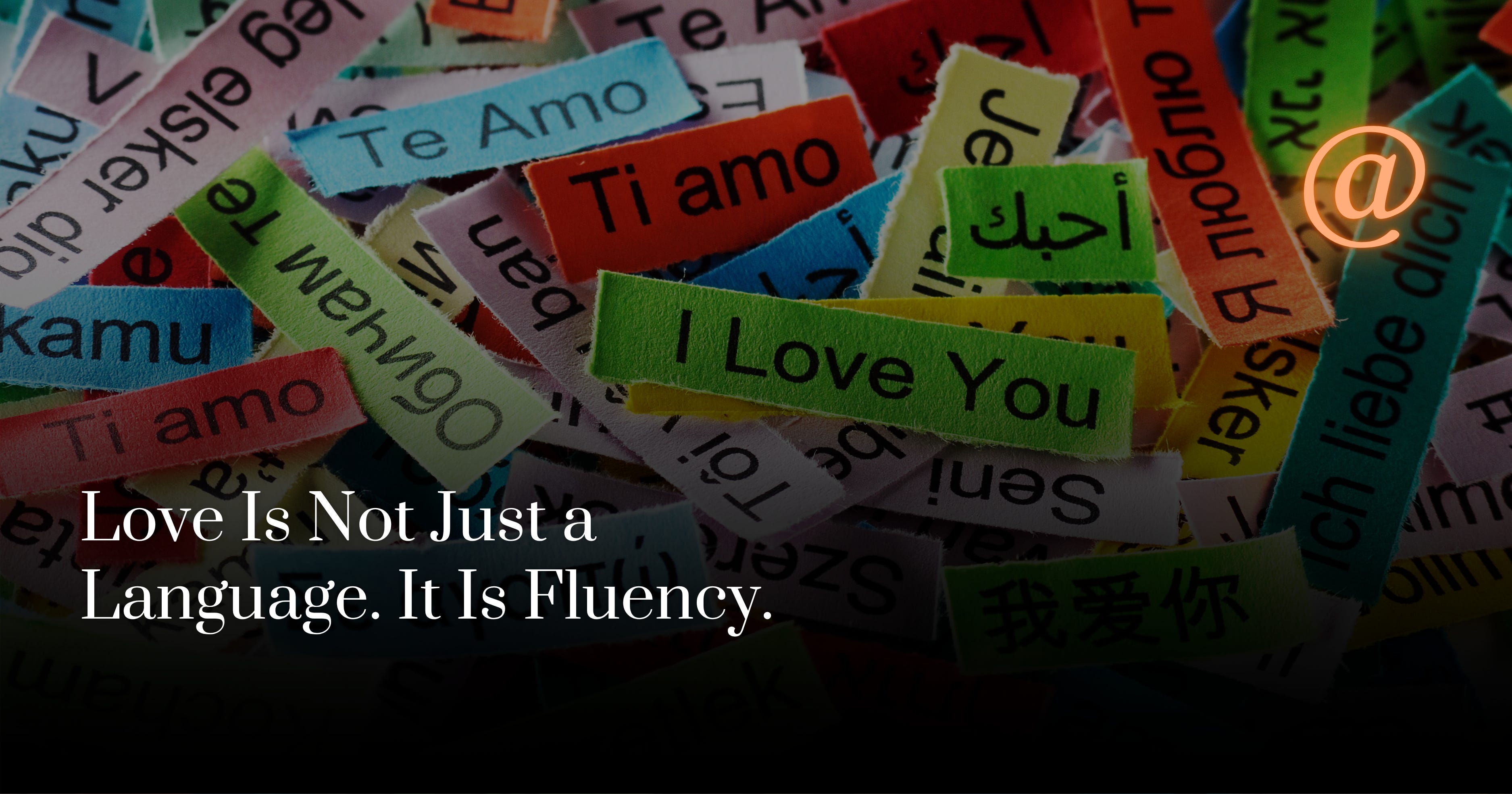
Love Is Not Just a Language. It Is Fluency.
We have become very good at asking people one question:
What is your love language?
It has become casual relationship vocabulary at this point. Someone asks how you receive love, and people answer with the familiar categories: gifts, quality time, physical touch, words of affirmation, acts of service.
And there is nothing wrong with knowing the answer.
It matters to know how you receive love. It matters to understand what makes you feel seen, valued, chosen, appreciated, and safe. There is power in being able to say, “This is what love feels like to me.”
But I think the conversation usually stops too soon.
We ask people how they receive love, but we do not always ask how well they give it. We ask what language makes them feel loved, but we do not ask what language they are willing to learn for someone else.
Maybe the better question is not only, “How do you receive love?”
Maybe the better question is:
What language are you willing to learn?
Because love is not only about knowing what makes us feel valued. It is also about learning how someone else feels valued.
A lot of people are fluent in their own needs, but barely conversational when it comes to their partner’s. And maybe that is where many relationships break down. Not always from a lack of love, but from a lack of fluency.
Some people are fluent in asking for love, but not fluent in offering it.
That is the part I think we do not talk about enough.
Knowing the Language Is Not the Same as Knowing the Dialect
I speak three languages, but I do not speak all three with the same fluency.
English is my primary language. That is the language I can express myself in with the most depth. I can explain my thoughts, argue a point, tell a story, make a joke, be vulnerable, and have a layered conversation.
I speak Creole too. I can speak it well enough to get by day to day. I can understand it. I can communicate. I can move through the language with some comfort. But I would not say I can have the same kind of intellectual or deeply nuanced conversation in Creole that I can have in English.
Then there is Spanish.
I know enough Spanish to order food.
Outside of that, I am pretty much lost.
And I think some people speak love the way I speak Spanish. They know enough to order what they want, but not enough to have a real conversation.
They know how to say, “I want quality time.”
They know how to say, “I like gifts.”
They know how to say, “I need acts of service.”
They know how to say, “I want more affection.”
But when it is time to understand what those things mean to someone else, they struggle. They know the name of the language, but they do not know the dialect.
That is an important difference.
The love language category is not the whole language. It is only the language family. The real meaning is in the dialect.
When someone says their love language is gifts, that does not tell you everything. What kind of gifts? Luxury gifts? Practical gifts? Sentimental gifts? Surprise gifts? Handmade gifts? Expensive gifts? Gifts that show you listened? Gifts that solve a problem? Gifts that make them feel spoiled? Gifts that make them feel remembered?
When someone says their love language is quality time, that still needs more understanding. Do they mean sitting in the same room? Going out on dates? Deep conversation? Playing games? Doing puzzles? Cooking together? Taking walks? Watching movies? Sitting in silence? Being intellectually stimulated? Being emotionally present?
The category gives you a starting point.
The dialect tells you how to actually reach them.
And that is where a lot of people miss each other. They think because they know the category, they know the person. But the love language is not a shortcut around learning someone. It is an invitation to study them more carefully.
The love language is the category.
The dialect is the person.
My Dialect of Quality Time Is Curiosity
One of my love languages is quality time.
But even saying that does not fully explain what I mean.
For me, quality time is not just being around someone. It is not just sitting in the same room, watching the same show, or spending hours together while barely being present. My version of quality time is engagement.
More specifically, my dialect of quality time is curiosity.
I like deep conversation. I like learning what makes a person tick. I like understanding the why behind what they do, how they think, what shaped them, what they value, what they fear, what they dream about, and how they became who they are.
To me, that is intimacy.
When I care about someone, I want to know them beyond the surface. I want to understand the layers. I want to know the story behind the behavior. I want to know what lives underneath the first answer they gave me.
And I want that in return.
I want someone to want to understand me too. Not just what I do, but why I do it. Not just what I think, but how I arrived there. Not just who I am in public, but who I am when I am being honest.
To me, that kind of curiosity feels like connection.
But I have also had conversations with friends who say quality time is their love language, and their version of it is not the same as mine.
Some of them would find my version annoying. To them, all those questions might feel like pestering. They may not experience deep conversation as intimacy. They may experience it as pressure. They may feel like they are being interrogated instead of being loved.
And that is what makes this so important.
We could both say our love language is quality time and still mean two completely different things.
For me, quality time may mean picking each other’s brains and learning each other deeply.
For someone else, quality time may mean peace. It may mean laughter. It may mean doing activities together. It may mean watching a movie, taking a walk, cooking dinner, or just being in the same space without having to explain themselves.
Same love language.
Different dialect.
That is why it is not enough to know the category. You still have to learn the person.
Gift Giving Is Not Always the Same Gift
The same thing happens with gift giving.
Someone may say, “My love language is gifts.”
That sounds simple, but it is not.
Let’s say you buy someone a first aid kit. On the surface, that may not seem romantic. It may not seem exciting. It may not look like the kind of gift someone would post online with heart emojis and a caption about being spoiled.
But context matters.
What if that person is handy around the house? What if they are always fixing things, using power tools, working with their hands, or taking on projects where they could easily hurt themselves?
In that case, a first aid kit could be a deeply thoughtful gift.
It could say:
“I notice what you do.”
“I think about your safety.”
“I care about you being prepared.”
“I see the risks you take.”
“I want you to be able to take care of yourself if something happens.”
That is love.
At least, it can be.
But will the person receive it as love?
That depends on their dialect.
For one person, that gift may feel incredibly thoughtful. They may think, “You pay attention to me. You noticed something practical I needed before I even asked.”
For another person, especially on a birthday or special occasion, they may think, “You bought me a first aid kit? That is what you thought would make me feel celebrated?”
Neither response is automatically wrong.
The issue is that both people may be using the same word, “gifts,” but meaning completely different things.
For one person, gifts mean practicality. For another, gifts mean luxury. For one person, gifts mean usefulness. For another, gifts mean romance. For one person, gifts mean, “You noticed what I need.” For another, gifts mean, “You saw what I desire.”
That is why fluency matters.
Because love is not just doing the action. It is understanding how the action lands.
Sometimes Love Is Present, but the Translation Is Poor
I think this is where many relationships get stuck.
One person feels like they are giving love. The other person does not feel loved. And then both people become defensive.
The giver says, “But I do love you.”
The receiver says, “But I do not feel loved by you.”
The giver says, “I do things for you.”
The receiver says, “But you do not do the things that make me feel seen.”
The giver says, “That is just not how I show love.”
The receiver says, “But why is the way you show love the only way that counts?”
That is the tension.
Sometimes love is present, but the translation is poor.
That does not mean the love is fake. It does not mean the giver has no good intentions. It does not mean the receiver is ungrateful. But it does mean something is getting lost between what is being offered and what is being received.
And untranslated love can still feel like loneliness.
That line may sound heavy, but I think many people understand it.
There are people who have been in relationships where the other person technically loved them. Maybe they provided. Maybe they helped. Maybe they showed up in certain ways. Maybe they did what they believed love was supposed to look like.
But still, the other person felt emotionally hungry.
Not because there was no love at all, but because the love was not reaching them in a way they could feel.
It is like standing in front of someone who is speaking a language you only halfway understand. You may catch a word here and there. You may understand the intention. You may know they are trying to communicate. But after a while, not being understood still becomes exhausting.
Love cannot only be measured by the sincerity of the person giving it.
It also has to be measured by whether it reaches the person receiving it.
Intention Matters, but So Does Impact
This is where we have to be careful.
I do not believe the receiver is always automatically right. Sometimes people ask for love in ways that are unrealistic, unfair, unhealthy, or rooted in wounds they have not addressed. Sometimes people expect their partner to constantly prove love because they are afraid, insecure, or emotionally unsettled.
So no, love languages should not become a way to make endless demands.
But I also do not believe good intentions should be treated as enough.
You cannot keep missing someone and assume they should be satisfied because you meant well. You cannot keep loving someone only in the way that is easiest for you and then resent them for not feeling full.
At some point, love has to become curious.
Not defensive.
Curious.
Curious enough to ask, “What did that mean to you?”
Curious enough to ask, “Did that make you feel loved?”
Curious enough to ask, “When you say you want quality time, what does that actually look like?”
Curious enough to ask, “When you say gifts matter to you, what makes a gift feel thoughtful?”
Curious enough to ask, “When you say you need help, do you want me to take initiative, or do you want us to do it together?”
Curious enough to ask, “Am I loving you in a way that reaches you, or only in a way that makes sense to me?”
That kind of curiosity requires maturity.
Because it forces us to admit that our version of love is not the only version.
Love Requires Studying
Maturity is not simply taking your understanding of a love language as fact.
Maturity is understanding how your partner perceives it.
That means you have to pay attention.
People tell you how they feel loved even when they are not directly saying it. They reveal it in what they admire. They reveal it in what they remember. They reveal it in what they complain about. They reveal it in what softens them. They reveal it in what disappoints them. They reveal it in what they keep asking for.
If your person likes quality time, observe how they want that time spent.
Do they light up during thoughtful conversation? Do they love when you ask questions and let them talk through their ideas? Do they enjoy puzzles, games, or things that are mentally stimulating? Do they want adventure? Do they want quiet presence? Do they want eye contact and undivided attention?
If your person likes gifts, observe what kind of gifts matter.
Do they appreciate practical things that make life easier? Do they love luxury and beauty? Do they care more about the cost, the thought, the timing, the presentation, or the fact that you remembered something small they said months ago?
If your person likes acts of service, observe what kind of service makes them feel loved.
Do they want help before they ask? Do they want relief from something that overwhelms them? Do they want partnership? Do they want you to notice what needs to be done? Do they want protection? Do they want consistency?
Everyone communicates differently.
And when you love someone, part of the work is learning how they identify love, how they communicate love, and how they receive love.
It is not just about the language.
It is about fluency.
Love Requires Stretching, Not Self-Abandonment
Learning someone’s love language does not mean losing yourself.
That is important.
Love requires stretching, not self-abandonment.
Stretching means, “This may not come naturally to me, but I care enough to try.”
Self-abandonment means, “I have to become someone I am not in order to keep you.”
Those are not the same.
If someone needs words of affirmation, stretching may mean learning to be more verbally expressive. It may mean saying thank you more often. It may mean telling them what you appreciate instead of assuming they already know.
But it does not mean performing emotions you do not feel.
If someone needs quality time, stretching may mean being more intentional with your schedule. It may mean putting your phone down. It may mean planning something instead of always waiting for them to initiate.
But it does not mean having no personal space.
If someone needs gifts, stretching may mean becoming more thoughtful. It may mean paying attention to what they like. It may mean remembering small details.
But it does not mean spending beyond your means or proving love through financial pressure.
If someone needs physical touch, stretching may mean being more affectionate, more tender, more present.
But it does not mean ignoring your own boundaries with your body.
Healthy love does not ask you to disappear.
It asks you to grow.
And there is a difference.
The goal is not for one person to become fluent while the other refuses to study. The goal is mutual fluency. The goal is two people willing to learn each other with care, humility, and patience.
Because love should not be one person constantly translating while the other person keeps saying, “This is just how I am.”
At some point, “This is just how I am” becomes a refusal to grow.
And refusal to grow can make love feel one-sided.
Love Is Fluency
Maybe love languages were never supposed to be emotional name tags.
Maybe they were never meant to be something we hand to a partner and say, “Here, figure me out.”
Maybe they were meant to be a starting point.
A way of saying, “This is where you can begin learning me.”
Because love is not just finding someone who already speaks your language perfectly.
Love is not just finding someone who speaks your language. It is finding someone willing to learn your dialect while you learn theirs.
That is the part that matters.
Someone may not be naturally fluent in the way you receive love. They may stumble at first. They may mispronounce things emotionally. They may need correction, patience, and practice.
But willingness matters.
Effort matters.
Attention matters.
Humility matters.
Because when someone cares about you, they should care whether their love is reaching you.
And when you care about someone, you should care about the same.
So maybe the question is not just, “What is your love language?”
Maybe the better questions are:
How well do I speak love?
How well do I listen?
Do I know the category, or do I know the dialect?
Am I only fluent in what I want, or am I learning how to offer love in a way someone else can receive?
Because love is not just a language.
Love is fluency.
Wow
this was beautifull